The True Cost of a Mortgage: Breaking Down Principal, Interest, Taxes, and Insurance

The True Cost of a Mortgage: Breaking Down Principal, Interest, Taxes, and Insurance

When you take on a mortgage, the monthly payment you commit to is more than just paying back your loan. It’s a combination of several components that together make up the true cost of a mortgage. Understanding your mortgage payment breakdown is essential for budgeting, avoiding surprises, and making smarter financial decisions as a homeowner.

This guide explains each part of your mortgage payment—principal, interest, taxes, and insurance (PITI)—and shows how they impact your finances in the short and long term.

Mortgage Payment Breakdown: The Four Core Components

Mortgage payments are usually made up of four major parts:

1. Principal

  • The principal is the amount you borrowed to buy your home.
  • Each month, a portion of your payment reduces your outstanding balance.
  • Over time, more of your payment goes toward principal as interest decreases.

2. Interest

  • Interest is the lender’s charge for letting you borrow money.
  • It’s calculated as a percentage of your remaining loan balance.
  • Your interest rate depends on market conditions, loan type, and personal financial factors (credit score, down payment, debt-to-income ratio).

3. Taxes

  • Property taxes are levied by local governments.
  • Lenders often collect them monthly and place them in an escrow account, paying them on your behalf when due.
  • Tax rates vary widely depending on your location.

4. Insurance

  • Homeowners insurance protects against risks like fire, theft, or natural disasters.
  • Some lenders also require mortgage insurance if your down payment is less than 20%.
  • Like taxes, insurance payments may be escrowed into your monthly mortgage bill.

This combination—Principal + Interest + Taxes + Insurance (PITI)—represents your total mortgage obligation each month.

Example of a Mortgage Payment Breakdown

Let’s say you buy a $250,000 home with a $200,000 mortgage at 5% interest for 30 years.

  • Monthly Principal & Interest: ≈ $1,073
  • Property Taxes: ≈ $200
  • Homeowners Insurance: ≈ $100

Total Monthly Mortgage Payment = $1,373

How Each Component Changes Over Time

  • Principal: Starts small but increases as you pay down your loan.
  • Interest: Starts high but decreases as your balance shrinks.
  • Taxes & Insurance: May increase due to reassessments or premium hikes.

Factors That Influence Mortgage Payment Breakdown

  1. Loan Type & Term

    • Fixed vs adjustable-rate mortgages.

    • 15-year vs 30-year terms.

  2. Location

    • Property taxes vary by city, county, and country.

  3. Down Payment

    • Larger down payments reduce principal and may eliminate mortgage insurance.

  4. Creditworthiness

    • Strong credit scores often secure lower interest rates.

Hidden Costs Beyond PITI

While PITI covers the basics, homeowners should also budget for:

  • Maintenance & repairs
  • HOA fees (if applicable)
  • Utilities & upgrades

Why Understanding Mortgage Payment Breakdown Matters

  • Budget planning: Avoid underestimating housing costs.
  • Loan comparisons: Helps you evaluate affordability across lenders.
  • Long-term strategy: Enables smarter refinancing and extra payment decisions.

Tips to Reduce Your Mortgage Costs

  • Make extra payments on principal.
  • Refinance to a lower rate when possible.
  • Increase your down payment to cut insurance costs.
  • Shop around for insurance providers.
  • Appeal your property tax assessment if it seems too high.

FAQs on Mortgage Payment Breakdown

What does PITI stand for?

It stands for Principal, Interest, Taxes, and Insurance—the four main components of a mortgage payment.

Do all mortgages include taxes and insurance?

Not always—some homeowners pay taxes and insurance separately, though lenders often require escrow.

Can my mortgage payment change over time?

Yes—while principal and interest stay fixed on a fixed-rate loan, taxes and insurance can increase.

What is mortgage insurance?

It’s insurance that protects the lender if you default, usually required with small down payments.

How much of my first payment goes toward principal?

A small portion—most early payments go to interest. Over time, the principal share grows.

Are property taxes the same everywhere?

No, they vary greatly depending on your local government and property value.

Can I lower my homeowners insurance costs?

Yes, by comparing providers, improving home safety, or bundling policies.

What happens if I don’t escrow taxes and insurance?

You’ll need to budget and pay them directly, which requires discipline.

How can I reduce my interest payments?

By improving your credit score, refinancing, or making extra principal payments.

Is HOA included in PITI?

No, HOA fees are separate and should be budgeted independently.

Do adjustable-rate mortgages affect PITI?

Yes—your interest portion may change when the rate resets.

What’s the biggest factor in determining monthly mortgage payments?

The interest rate and loan size—these drive the largest portion of your costs.

Conclusion

Your mortgage payment isn’t just about repaying a loan—it’s a mix of principal, interest, taxes, and insurance. By understanding the full mortgage payment breakdown, you can budget more accurately, make informed financial decisions, and even find ways to lower your costs.

The more you understand your PITI, the more control you’ll have over your journey to full homeownership.

How Mortgage Interest Rates Are Determined and Why They Matter

How Mortgage Interest Rates Are Determined and Why They Matter

When buying a home, few things affect your finances as much as the mortgage interest rate you receive. Even a small difference—say 5.0% versus 5.5%—can add up to tens of thousands of dollars over the life of a loan. But how are mortgage interest rates determined, and why do they matter so much to homeowners and investors alike?

This guide breaks down the factors that influence mortgage interest rates, how they affect your monthly payments, and what you can do to secure the best possible deal.

What Are Mortgage Interest Rates?

A mortgage interest rate is the cost of borrowing money to buy a property. It’s expressed as a percentage of your loan balance and is included in your monthly mortgage payment.

  • Principal: The original loan amount.
  • Interest: The lender’s charge for lending you money, based on your rate.
  • Monthly payment: A combination of principal and interest, plus taxes and insurance (if applicable).

How Mortgage Interest Rates Are Determined

Mortgage rates are shaped by a mix of global, national, and personal financial factors.

1. Central Bank Policies

  • Central banks (like the Federal Reserve, European Central Bank, or Bank of England) influence lending costs by adjusting benchmark rates.
  • When central banks raise rates to control inflation, mortgage rates usually rise too.

2. Inflation Trends

  • High inflation reduces the purchasing power of money, prompting lenders to demand higher rates.
  • Lower inflation generally supports lower mortgage rates.

3. Bond Market Yields

  • Mortgage rates often follow government bond yields (like U.S. Treasuries or German Bunds).
  • When bond yields go up, mortgage rates usually climb.

4. Lender Operating Costs and Risk Premiums

  • Lenders build in a margin to cover risks, defaults, and operating expenses.
  • Riskier lending environments lead to higher rates.

5. Borrower-Specific Factors

Your personal financial profile plays a major role:

  • Credit score: Higher scores usually mean lower rates.
  • Down payment: A bigger down payment reduces lender risk.
  • Debt-to-income ratio (DTI): Lower DTI makes you a safer borrower.
  • Loan term: Shorter terms often carry lower rates.

Why Mortgage Interest Rates Matter

1. Impact on Monthly Payments

A lower rate directly reduces your monthly mortgage cost.

Example:

  • $200,000 loan at 5% = $1,073/month.
  • $200,000 loan at 6% = $1,199/month.
    That’s $126 more each month, or over $45,000 extra over 30 years.

2. Home Affordability

  • Higher rates reduce the amount you can borrow for the same budget.
  • Lower rates make homeownership more accessible.

3. Long-Term Wealth Building

  • Lower interest rates mean more money goes toward principal and equity.
  • Over time, this builds financial security.

4. Investment Returns

For real estate investors, interest rates affect rental property profitability and cash flow.

Fixed vs. Variable Mortgage Interest Rates

  • Fixed-rate mortgages: The interest rate stays the same for the entire loan term. Great for stability.
  • Variable/adjustable-rate mortgages (ARMs): The rate changes over time, usually tied to a market index. Riskier but may start lower.

How to Get the Best Mortgage Interest Rate

  1. Improve Your Credit Score

    • Pay bills on time, reduce debt, and avoid new credit inquiries.

  2. Increase Your Down Payment

    • Lenders may reward a 20% or higher down payment with better rates.

  3. Shop Around

    • Compare rates from banks, credit unions, and online lenders.

  4. Choose the Right Loan Term

    • 15-year loans usually have lower rates than 30-year loans.

  5. Consider Timing

    • Economic conditions, inflation, and central bank moves affect rates. Lock in when rates are favorable.

Common Misconceptions About Mortgage Interest Rates

  • Myth 1: Everyone gets the same rate.

Reality: Rates are highly personalized.

  • Myth 2: The lowest advertised rate is always the best.

Reality: Closing costs and fees also matter.

  • Myth 3: Once you get a rate, you’re stuck forever.

Reality: Refinancing allows you to change your rate later.

Mortgage Interest Rate Impact on Monthly Payments

Here’s an example based on a $200,000 loan with a 30-year term:

Interest RateMonthly PaymentTotal Interest Paid (30 years)Total Cost of Loan
4.0%$955$143,739$343,739
4.5%$1,013$164,813$364,813
5.0%$1,073$193,256$393,256
5.5%$1,136$218,694$418,694
6.0%$1,199$231,676$431,676

Key Takeaways:

  • A 1% increase (from 5.0% to 6.0%) raises monthly payments by $126.
  • Over 30 years, that adds up to $38,420 more in interest.
  • Even a half-percent difference can save or cost you tens of thousands.

FAQs on Mortgage Interest Rates

What exactly are mortgage interest rates?

They are the cost of borrowing money from a lender, expressed as a percentage of your loan balance.

Who decides mortgage interest rates?

Rates are influenced by central banks, the bond market, inflation, and lender risk assessments.

Why do mortgage interest rates change daily?

They fluctuate with market conditions, investor demand for bonds, and economic news.

Do I have control over my mortgage interest rate?

Yes—your credit score, down payment, and loan term can significantly affect your rate.

What’s the difference between APR and interest rate?

APR includes the interest rate plus fees, giving a more complete cost picture.

Are fixed or variable rates better?

Fixed rates offer stability, while variable rates may save money short term but carry risk.

How do inflation and interest rates connect?

Higher inflation usually leads to higher mortgage interest rates.

Can I lower my rate after taking a mortgage?

Yes, through refinancing if market rates drop or your credit improves.

Do all countries have the same mortgage interest rates?

No, they vary by economic conditions, lending standards, and government policies.

How much does a 1% difference in rate matter?

A lot—over 30 years, it can mean tens of thousands in extra interest.

Are online lenders’ rates better than banks’?

Sometimes, but always compare total costs, not just advertised rates.

When is the best time to lock in a mortgage rate?

When you’re satisfied with the rate and ready to proceed, especially if rates are expected to rise.

Conclusion

Mortgage interest rates may seem like just another number, but they carry huge financial weight. Understanding how they’re determined—and what you can do to influence your personal rate—can save you money, boost your home affordability, and improve your long-term wealth.

Whether you’re buying your first home or refinancing, paying close attention to mortgage interest rates is one of the smartest financial moves you can make.

Understanding Mortgage Amortization: How Your Payments Are Structured

Understanding Mortgage Amortization: How Your Payments Are Structured

When you take out a home loan, you don’t just pay back the money you borrowed—you also pay interest to the lender. But how are these payments structured over time? This is where mortgage amortization comes in. Understanding it can help you plan your finances, reduce interest costs, and even pay off your home faster.

What Is Mortgage Amortization?

Mortgage amortization is the process of gradually paying off a loan through scheduled monthly payments. Each payment is split between:

  • Principal – the portion that reduces your loan balance.
  • Interest – the lender’s charge for borrowing money.

At the beginning of the loan term, a larger share of your payment goes toward interest. Over time, more goes toward the principal.

How Mortgage Amortization Works

Imagine you take a 30-year fixed-rate mortgage. Even though your monthly payment stays the same, the way it’s applied changes:

  • Early years: Most of your payment goes to interest.
  • Later years: More of your payment goes toward the principal.

This gradual shift is called an amortization schedule, a table that shows how each payment is allocated.

Example of Mortgage Amortization

Let’s say you borrow $200,000 at 5% interest for 30 years.

  • Monthly payment: about $1,073.
  • In the first payment, around $833 goes to interest and $240 to principal.
  • By the 20th year, the majority of each payment goes to principal.

This shows how time affects the breakdown of your payments.

Factors That Affect Mortgage Amortization

Several elements influence your amortization schedule:

Loan Term

  • Shorter terms (15 years) mean higher payments but faster payoff.
  • Longer terms (30 years) mean lower payments but more total interest.

Interest Rate

Higher rates mean more money goes toward interest, especially early on.

Extra Payments

Paying a little extra toward the principal each month can shorten your loan term and save thousands in interest.

Loan Type

  • Fixed-rate loans have consistent payments.
  • Adjustable-rate mortgages may change payment amounts after adjustments.

Benefits of Understanding Mortgage Amortization

  • Better budgeting – Know how much of your payment builds equity.
  • Interest savings – Plan extra payments strategically.
  • Homeownership goals – Estimate when you’ll fully own your property.
  • Refinancing decisions – See how starting over affects total interest.

Sample Mortgage Amortization Schedule (First Year)

Here’s a simplified example based on a $200,000 loan at 5% interest over 30 years (monthly payment ≈ $1,073):

Payment #Total PaymentInterest PaidPrincipal PaidRemaining Balance
1$1,073$833$240$199,760
2$1,073$832$241$199,519
3$1,073$831$242$199,277
4$1,073$830$243$199,034
5$1,073$829$244$198,790
6$1,073$828$245$198,545
7$1,073$826$247$198,298
8$1,073$825$248$198,050
9$1,073$824$249$197,801
10$1,073$823$250$197,551
11$1,073$822$251$197,300
12$1,073$821$252$197,048

What this shows:

  • Early payments mostly cover interest, with only small amounts going toward the principal.
  • Over time, more of your payment reduces the loan balance, and less goes to interest.

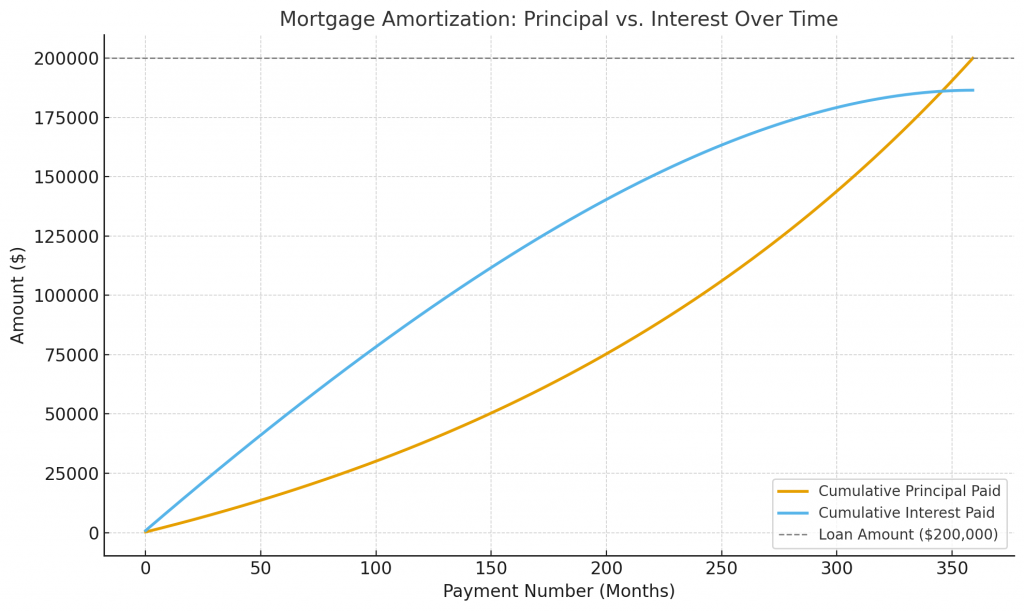
Here’s the visual chart showing how mortgage payments are split:

  • In the early years, interest dominates.
  • Over time, principal takes over, helping you build equity.
  • The dashed line marks the original loan amount ($200,000).

Tips to Manage Your Mortgage Amortization

  • Make biweekly payments instead of monthly to pay off faster.
  • Apply windfalls (bonuses, tax refunds) toward principal.
  • Refinance to a shorter term if you can afford higher payments.
  • Track your amortization schedule regularly to stay on top of progress.

FAQs About Mortgage Amortization

What is mortgage amortization in simple terms?

It’s the process of paying off your loan over time through regular payments of principal and interest.

Do all mortgages use amortization?

Most do, but some special loans (like interest-only mortgages) work differently.

Why do I pay more interest at the start of my mortgage?

Because interest is calculated on the remaining loan balance, which is highest at the beginning.

Can I speed up my mortgage amortization?

Yes, by making extra payments toward the principal.

What is an amortization schedule?

A table showing how each payment is divided between principal and interest.

How does loan length affect amortization?

Shorter loans build equity faster and reduce total interest.

What happens if I refinance my mortgage?

Your amortization schedule resets with the new loan.

Is biweekly payment better than monthly?

Yes, because you make one extra payment per year, shortening the loan term.

Do adjustable-rate mortgages affect amortization?

Yes, because your payment amounts may change when interest rates reset.

How does paying extra on principal help?

It reduces your loan balance faster, lowering future interest costs.

What is negative amortization?

When payments don’t cover interest, causing your loan balance to increase instead of decrease.

How do I calculate my own mortgage amortization?

You can use online mortgage calculators or request an amortization schedule from your lender.

Final Thoughts

Understanding mortgage amortization gives you control over your home loan. By knowing how payments are structured, you can make smarter financial decisions—whether that means refinancing, paying extra on principal, or sticking to your schedule. The more you understand amortization, the more effectively you can build equity and achieve financial freedom through homeownership.

Fixed-Rate vs. Adjustable-Rate Mortgages: Which One Is Right for You?

Fixed-Rate vs. Adjustable-Rate Mortgages: Which One Is Right for You?

When buying a home, one of the most important decisions you’ll face is choosing between a fixed-rate mortgage and an adjustable-rate mortgage (ARM). Both options have unique advantages and drawbacks, and the right choice depends on your financial situation, risk tolerance, and long-term goals. This guide on fixed vs adjustable rate mortgages will help you understand how they work, their pros and cons, and how to decide which is best for you.

What Is a Fixed-Rate Mortgage?

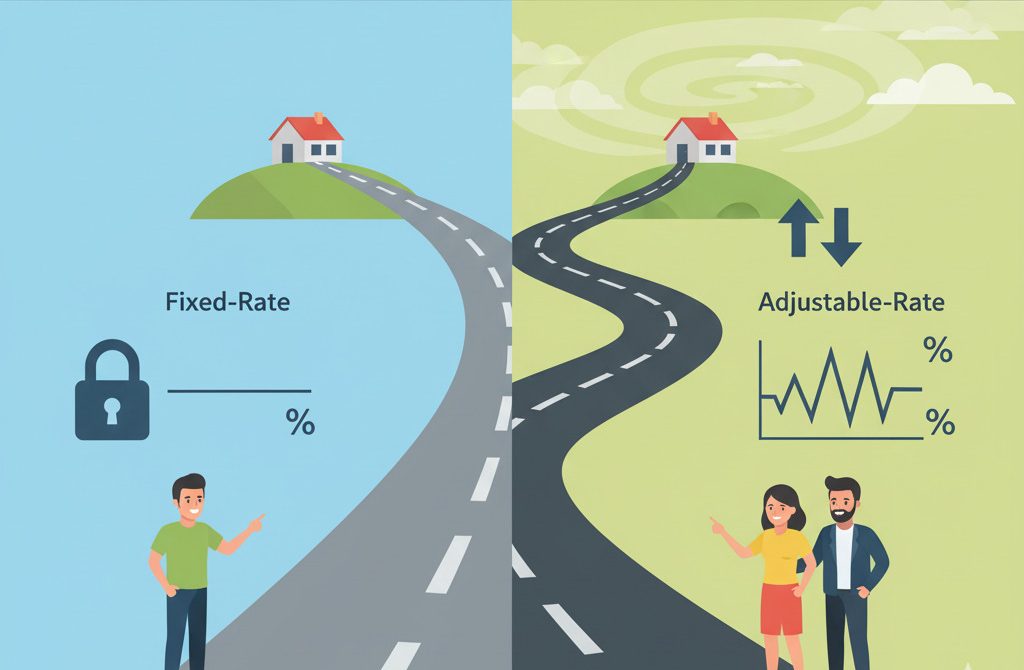
A fixed-rate mortgage is a home loan where the interest rate remains the same for the entire term of the loan. Whether you choose a 15-, 20-, or 30-year term, your monthly principal and interest payments will stay constant.

Key Benefits of Fixed-Rate Mortgages:

  • Predictability – Your payments never change, making budgeting easier.
  • Long-term security – Ideal if you plan to stay in your home for many years.
  • Protection from interest rate hikes – You won’t be affected if market rates rise.

Potential Downsides:

  • Higher initial interest rates compared to ARMs.
  • Less flexibility if you plan to move or refinance soon.

What Is an Adjustable-Rate Mortgage (ARM)?

An adjustable-rate mortgage (ARM) starts with a lower interest rate that adjusts periodically based on market conditions. For example, a 5/1 ARM means the interest rate is fixed for the first 5 years, then adjusts annually.

Key Benefits of Adjustable-Rate Mortgages:

  • Lower initial rates – Great for reducing payments in the early years.
  • Cost savings – Ideal if you plan to sell or refinance before the rate adjusts.
  • Potential benefit from falling interest rates – Your payments could decrease.
  • Potential Downsides:
  • Uncertainty – Payments may increase significantly after the initial fixed period.
  • Harder to budget long-term – Riskier if you plan to stay in your home long term.
  • Complex terms – Caps, margins, and adjustment rules can be confusing.

Fixed vs Adjustable Rate Mortgages: A Side-by-Side Comparison

FeatureFixed-Rate MortgageAdjustable-Rate Mortgage (ARM)
Interest RateConstant for the life of the loanStarts lower, changes periodically
Monthly PaymentsStable and predictableMay rise or fall over time
Best ForLong-term homeownersShort-term homeowners or those expecting income growth
Risk LevelLow – no surprisesHigher – depends on market rates
FlexibilityLess flexibleMore flexible, especially for short-term plans

How to Decide Which Mortgage Is Right for You

When comparing fixed vs adjustable rate mortgages, consider these factors:

How long you plan to stay in the home

  • Long-term: Fixed-rate is usually better.
  • Short-term: ARM may save you money.

Your risk tolerance

  • Prefer stability? Choose fixed-rate.
  • Comfortable with some uncertainty? ARM could work.

Current interest rate environment

  • If rates are low, locking in a fixed-rate may be wise.
  • If rates are high but expected to fall, an ARM could help.

Your income stability

  • Fixed-rate fits those with steady income.
  • ARM may suit those expecting higher income in the future.

FAQs About Fixed vs Adjustable Rate Mortgages

What is the main difference between fixed and adjustable-rate mortgages?

Fixed-rate mortgages have constant interest rates, while ARMs start low but change over time.

Are adjustable-rate mortgages riskier?

Yes, because future payments depend on market interest rates.

Which loan type has lower initial payments?

ARMs usually start with lower payments compared to fixed-rate mortgages.

Is a fixed-rate mortgage always better?

Not necessarily—it’s better for long-term stability, but ARMs can save money short-term.

What does a 5/1 ARM mean?

It means the rate is fixed for 5 years, then adjusts annually.

Can I refinance an ARM into a fixed-rate loan later?

Yes, many homeowners refinance if rates start rising.

Do ARMs ever result in lower payments over time?

Yes, if market interest rates decrease.

Why do fixed-rate mortgages have higher rates than ARMs?

Lenders charge more for the security of a fixed rate.

Which mortgage type is best during high inflation?

A fixed-rate mortgage, since it locks in your payments.

What happens when an ARM adjusts?

Your interest rate and monthly payment may go up or down.

Do ARMs have limits on how much rates can rise?

Yes, they typically include caps on adjustments and lifetime limits.

How do I choose between fixed vs adjustable rate mortgages?

Base your choice on how long you’ll stay in the home, your risk tolerance, and market conditions.

Final Thoughts

Choosing between fixed-rate and adjustable-rate mortgages is one of the biggest financial decisions you’ll make as a homeowner. Fixed-rate mortgages offer stability and peace of mind, while ARMs provide lower initial costs and flexibility. The right choice depends on your time horizon, financial stability, and comfort with risk. By carefully weighing your options, you can select the mortgage that best fits your long-term financial goals.

What Is a Mortgage? A Beginner’s Guide to Home Financing

What Is a Mortgage? A Beginner’s Guide to Home Financing

For most people, buying a home is one of the biggest financial decisions they will ever make. Since very few individuals can afford to purchase a home outright with cash, mortgages exist as a practical way to finance a property. But for first-time buyers, the mortgage world can feel overwhelming—filled with jargon, different loan types, and complicated approval processes.

That’s where this beginners guide to mortgages comes in. We’ll break down the essentials: what a mortgage is, how it works, the types available, and the steps to get one. Whether you’re planning to buy your first home, upgrade to a bigger property, or simply want to understand home financing, this guide gives you the foundation you need to make informed choices.

What Is a Mortgage?

A mortgage is essentially a loan you take from a bank or lender to buy a house. Instead of paying the full price upfront, you borrow the money and repay it over a set number of years—usually 15, 20, or 30. The house itself acts as collateral, meaning the lender can take it back (through foreclosure) if you fail to make your payments.

Think of it as a partnership:

  • You bring a down payment (your share of the cost).
  • The lender provides the rest of the funds.
  • You repay in monthly installments that include principal, interest, taxes, and insurance.

How Do Mortgages Work?

Mortgages are structured as long-term loans with regular monthly payments. Each payment usually covers four key components, often remembered with the acronym PITI:

  1. Principal – The actual amount borrowed from the lender.
  2. Interest – The lender’s fee for letting you borrow money, expressed as an annual percentage rate (APR).
  3. Taxes – Property taxes owed to your local government, often collected by the lender and held in escrow.
  4. Insurance – Homeowners insurance, and sometimes mortgage insurance if you made a small down payment.

Over time, as you continue making payments, you pay down more principal and less interest—a process called amortization.

Key Mortgage Terms Every Beginner Should Know

To feel confident when talking to lenders, you’ll want to understand these basic terms:

  • Down Payment: The initial amount you pay upfront (commonly 10–20% of the home’s price).
  • Loan Term: The length of time you have to repay the loan (e.g., 30 years).
  • Fixed-Rate Mortgage: Interest rate stays the same throughout the loan.
  • Adjustable-Rate Mortgage (ARM): Interest rate changes periodically after an initial fixed period.
  • Escrow: An account managed by the lender to hold taxes and insurance payments.
  • Equity: The portion of your home you actually own (your share versus the bank’s).
  • Closing Costs: Fees and charges you pay when finalizing the mortgage.

Types of Mortgages

Different buyers have different needs, so mortgages come in several varieties. Here’s a breakdown:

1. Fixed-Rate Mortgage

  • Definition: The interest rate remains constant throughout the loan term.
  • Best for: Buyers who want predictable payments and long-term stability.
  • Pros: Stability, easy to budget.
  • Cons: May be higher initially than adjustable loans.

2. Adjustable-Rate Mortgage (ARM)

  • Definition: Starts with a lower fixed rate for a few years, then adjusts periodically based on market rates.
  • Best for: Buyers planning to sell or refinance before the rate adjusts.
  • Pros: Lower initial payments.
  • Cons: Risk of rising payments in the future.

3. Interest-Only Mortgage

  • Definition: You pay only the interest for a set period, then start paying principal.
  • Pros: Low initial payments.
  • Cons: Risky if property value falls or if you can’t handle higher payments later.

4. Government-Backed Loans (varies by country)

In some countries, governments offer special mortgage programs for first-time buyers, veterans, or low-income families.

Examples: FHA loans (U.S.), Help to Buy (U.K.), First Home Guarantee (Australia), Canada’s CMHC-insured mortgages.

5. Jumbo Loans

  • For very expensive properties that exceed standard loan limits.
  • Require higher credit scores and larger down payments.

Steps to Getting a Mortgage

Here’s what you can expect during the process:

  1. Check Your Credit Score – Lenders use it to assess your reliability.
  2. Determine Your Budget – Use online calculators to estimate affordability.
  3. Get Pre-Approved – A lender confirms how much they may lend you.
  4. House Hunting – Find a property within your budget.
  5. Submit Mortgage Application – Provide income, assets, and debt details.
  6. Underwriting – Lender reviews your application and documents.
  7. Closing – Sign documents, pay closing costs, and receive the keys.

How to Qualify for a Mortgage

1. Credit Score

The higher your score, the better your interest rate.

2. Debt-to-Income Ratio (DTI)

Lenders prefer your monthly debt payments (including mortgage) not to exceed 36–43% of your gross income.

3. Down Payment

The larger your down payment, the smaller your loan and monthly payments.

4. Stable Income

Proof of steady employment and income is essential.

Costs Involved in a Mortgage

Buying a home involves more than just monthly payments. Here are the main costs:

  • Closing Costs: 2–5% of the home price.
  • Property Taxes: Ongoing, varies by location.
  • Insurance: Homeowners and possibly mortgage insurance.
  • Maintenance: Regular upkeep and unexpected repairs.

Pros and Cons of Mortgages

Pros

  • Makes homeownership accessible.
  • Builds equity over time.
  • Potential tax advantages in some countries.

Cons

  • Long-term debt commitment.
  • Interest costs can be significant.
  • Risk of foreclosure if payments are missed.

Common Mistakes First-Time Buyers Make

  • Buying more house than they can afford.
  • Ignoring extra costs (taxes, insurance, maintenance).
  • Not shopping around for better mortgage rates.
  • Making large purchases before closing (which affects credit).

Tips for Choosing the Right Mortgage

  • Compare rates from multiple lenders.
  • Decide between fixed and adjustable rates based on how long you’ll stay in the home.
  • Consider total loan costs, not just monthly payments.
  • Seek professional financial advice if unsure.

Alternatives to Traditional Mortgages

  • Rent-to-Own Agreements: Part of rent goes toward purchasing the home.
  • Owner Financing: Seller provides financing instead of a bank.
  • Co-Ownership: Partnering with family or friends to buy property.

Real-Life Case Study: First-Time Buyer

Maria, a 29-year-old teacher, wanted to buy her first apartment. She saved up a 15% down payment and got pre-approved for a 25-year fixed-rate mortgage. By choosing a modest property within her budget, Maria secured predictable monthly payments and avoided stretching her finances too thin.

Conclusion

Mortgages may seem complicated at first, but once you understand the basics, the process becomes much less intimidating. The key is to know your financial situation, research your options, and choose the type of mortgage that best fits your long-term goals. With careful planning, your mortgage can become a stepping stone to building equity and long-term financial security.

FAQs About Beginners Guide to Mortgages

What is a mortgage in simple terms?

A mortgage is a loan you take to buy a home, with the property itself as collateral.

How long do mortgages usually last?

Common terms are 15, 20, or 30 years, though this varies by country.

Do I need a large down payment to get a mortgage?

Not always. Some programs allow as little as 3–5%, but higher down payments reduce your loan size and interest costs.

What’s the difference between fixed-rate and adjustable-rate mortgages?

Fixed rates stay the same for the entire loan; adjustable rates change after an initial period.

Can I get a mortgage with bad credit?

Yes, but interest rates will be higher, and options may be limited.

What are closing costs?

Fees paid at the end of the home-buying process, usually 2–5% of the home’s purchase price.

Is renting better than buying a home?

It depends on your lifestyle, financial stability, and long-term goals.

What happens if I miss a mortgage payment?

You may face late fees, credit score damage, and eventually foreclosure if payments are missed repeatedly.

Can I pay off my mortgage early?

Yes, but check if your lender charges prepayment penalties.

How much mortgage can I afford?

Most lenders suggest spending no more than 28–30% of your income on housing.

What is mortgage insurance?

Insurance that protects the lender if you default, usually required with small down payments.

Do mortgages exist outside the U.S.?

Yes—most countries offer mortgage products, though terms, regulations, and programs vary.